
By Associate Professor Tim Fawns and Dr Mahbub Sarkar
Posted Wednesday 22 October, 2025
The 2025 Monash Learning & Teaching Conference brought together a vibrant mix of Monash educators and colleagues from across Victorian institutions. Held at Monash College Docklands, this year’s conference centred on the theme Building Connections. From the opening remarks and keynote to the provocations, panels, and a dedicated “Building Connections” session, the idea of connection guided conversations about how people, programs, and ideas intersect to shape the future of learning and teaching.
Across the two days, around 300 participants joined each day, including 60 external attendees from institutions including the University of Melbourne, Deakin University, La Trobe University, RMIT University, Swinburne University, Federation University, Victoria University, Australian Catholic University, Monash College, and the Polytechnic Institute Australia. Active networking, both in person and online, was intentionally woven throughout, and meaningful connections were made not only within Monash but across institutions. External voices and perspectives challenged assumptions and deepened our collective understanding of teaching and learning. Connection was a way of learning, an act of care, a quiet form of resistance against fragmentation, and an invitation to imagine new possibilities together.
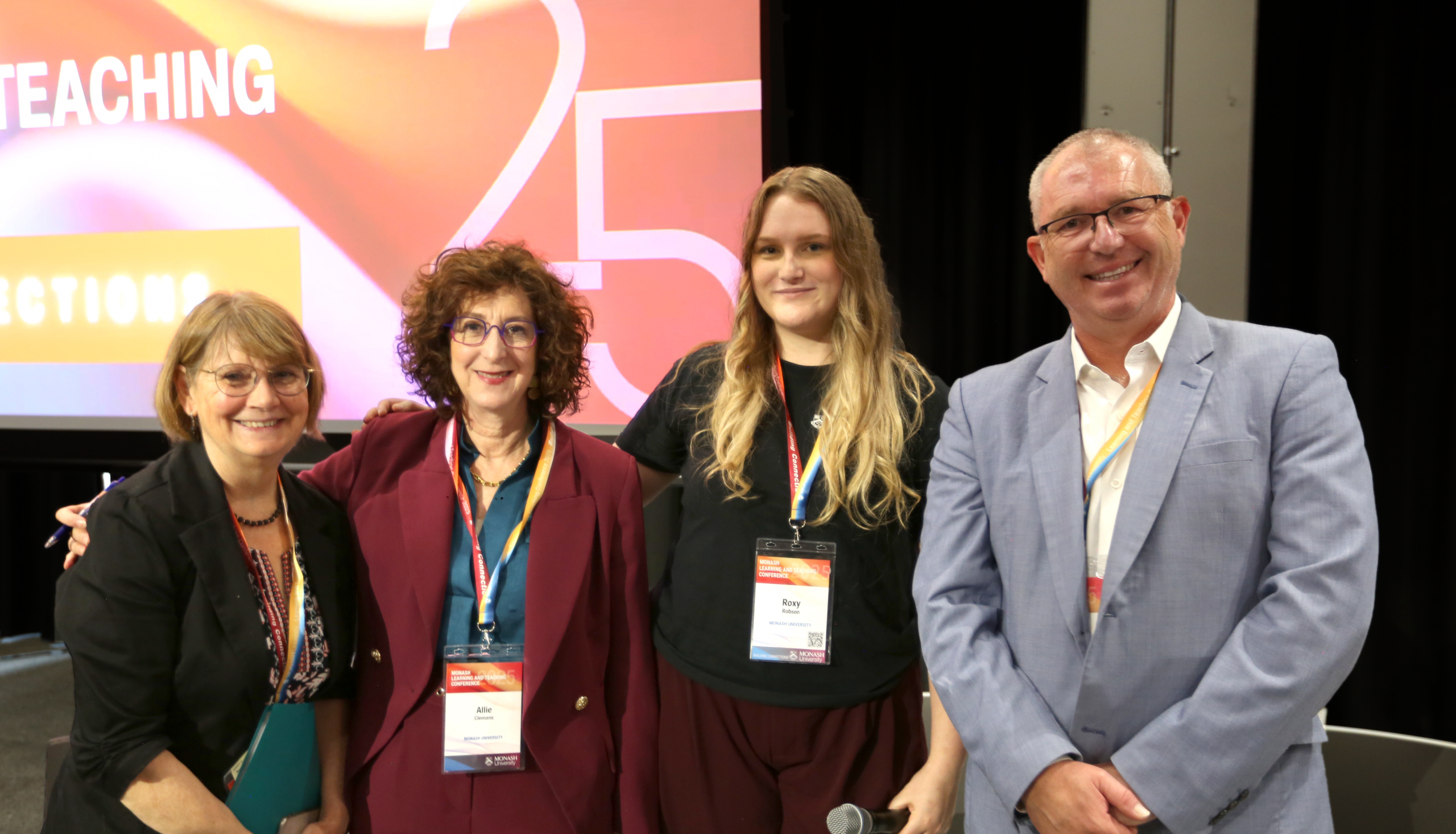
Our keynote, led by Emeritus Professor Liz Johnson (Deakin University), captured that spirit perfectly. It was a participatory dialogue that brought students, educators, leaders, and provocateurs into conversation, setting the tone for two days of collaboration and collective reflection. Liz invited participants to reflect on the role of connection in educational innovation and transformation. In dialogue with student representative Roxy Robson, Professor Allie Clemans (DVCE) and Professor Michael Phillips, Liz responded to provocations from three educators across the university (Professors Karen Adams, Kelly-Ann Allen, and Annette Bos), surfacing new questions and challenges about the fragility and sustainability of meaningful connections in complex institutional landscapes.
After morning tea, the keynote session morphed into a hands-on activity where participants engaged in dialogue and creative exchange. Each person collected four brightly coloured A5 postcards (or Padlet post-its for online participants): yellow for curriculum (“what we teach”), blue for students (“who we teach”), green for practice (“how we teach”), and pink for personal curiosities or challenges. On each card, participants wrote a question or challenge on their mind (e.g. designing assessment in relation to GenAI, supporting multilingual students, building an academic career). These prompted discussion, comparing of experiences, and identifying shared interests. When someone was sufficiently interested, they added their name and contact details to the card, committing to a follow-up conversation within the coming weeks. Tables and Padlets were covered in colourful cards with commitments to future conversation, collaboration and shared problem-solving. Each card became a thread in a growing network that we believe will continue beyond the conference. In a sector often stretched thin, this moment captured something essential. Change begins with conversation and commitment.
As one attendee put it:
“I thoroughly enjoyed the conference — it gave me a warm and fuzzy feeling. I think that’s because of the theme. I made some solid connections and already have plans to meet with someone next week to discuss classroom engagement. I didn’t eat much because I was too busy talking!”
— Dhayani Kirubaharan, Department of Accounting (Monash)
We look forward to checking in with participants to see which connections were sustained beyond the conference.


Programmatic thinking and visible evidence of learning
Poster sessions were followed by an intentionally spacious 90 minute networking lunch (plenty of space was left between sessions to encourage conversation). Then, insights from the Monash Programmatic Assessment and AI Review (PAAIR) project were showcased in a mini symposium where presenters from diverse disciplines demonstrated different approaches to programmatic thinking. This work connects with Monash’s broader strategic focus on making evidence of learning visible, not just to assure learning, but to foster trust, meaning, and engagement. A plenary panel, featuring Professor Ari Seligmann, Dr Helen Gniel, Professor Andrew Cain and student contributors explored how to design trustworthy and meaningful assessment in an era of generative AI. The student panellists emphasised the importance of clear communication, strong scaffolding, and valuing complex, relevant tasks that develop judgement and capability.
Day 2 began with three Parallel sessions—Futures, Leadership, and Evaluation—each offering a distinct lens on the changing landscape of higher education. Over 50 lightning talks across four rooms injected fast-paced energy into the day, with educators sharing five-minute bursts of innovation and reflection across four rooms. Later Parallel sessions on Collaboration, Education Research, and Inclusion looked at designing with people (not for them), recognising the value of education-focused career paths and encouraging and dismantling barriers to participation.
The conference closed with a Plenary Response session, chaired by Associate Professor Tim Fawns, with Associate Professor Laura Alfrey, Dr Filippe Oliveira, and Professor Kirsten Galbraith. The panel reflected on what had been learned, questioned, and imagined, and how Monash can continue building connections across people, programs, and ideas. The conference ended with a shared sense of momentum. We are confident that the conversations sparked over these two days about leadership, evidence, collaboration, inclusion, and the future of education will continue to evolve.


Insights and conversations
Across both days, one message came through loud and clear: connection in education is layered, complex, and human. In the keynote session, Provocateur Professor Karen Adams, Director of Gukwonderuk Indigenous Health Workforces Centre and Wiradjuri woman, challenged us to see Indigenous knowledge not as “culture,” but as a legitimate and vital form of knowledge relevant to everyone. Calls for valuing different forms of knowledge were also apparent in discussions about AI, authenticity, and frameworks that define what counts as learning within assessment. Another provocateur, Professor Kelly-Ann Allen, highlighted the critical role of student belonging for both wellbeing and as a foundation for academic success. The final provocateur, Professor Annette Bos, called on us to explicitly value our connections to biological ecosystems within our curriculum, not as an afterthought but as a foundation for thinking about what matters and why.
These ideas intertwined with Professor Liz Johnson’s metaphors of educational ecosystems and teaching villages, reminding us that effective teaching “takes a village” and is built through multiple layers of collaboration, support, and care. Across sessions, participants explored how to redistribute the work of education, through programmatic assessment, faculty partnerships, or institutional networks, to rebalance workloads and responsibility. The notion of distributed leadership also emerged as an important theme, framed not as authority or control but as a commitment to nurturing others. Discussions also examined the structures that enable or constrain educational leadership and innovation. For example, career progression and recognition for education-focused staff is an area of ongoing work across the sector. At the conference, this was related to the challenge of valuing scholarly education work alongside disciplinary research. In a Parallel session on education research, Tomas Zahora described the world of education research as a labyrinth—complex, under-supported, and often under-recognised. Yet, there is still plenty of great work happening, as demonstrated by posters and lightning talks that painted a picture of scholarly creativity, innovation, persistence, and shared learning across the Monash community.
Generative AI, as expected, was threaded through nearly every discussion. Encouragingly, it was not treated as a standalone issue but as part of a broader educational ecosystem. Rather than seeing AI as a problem to be solved, participants at the conference positioned it as one element in a rich, interconnected tapestry of knowledge, capability, and connection that defines contemporary higher education.


Looking forward: What it means for the sector
The Monash Learning and Teaching Conference highlighted the sector’s strong appetite for collaboration. Educators across institutions were eager to share practice, exchange ideas, and tackle the complex challenges facing higher education together. This willingness to connect and collaborate is a vital strength for the sector as it navigates a rapidly changing landscape. Within this context, Monash seeks to lead not through competition, but through collegiality, sharing expertise while learning from others, and fostering a culture of mutual support and innovation. By opening our doors and actively engaging across institutional boundaries, we are helping to lay the groundwork for lasting partnerships, deeper cross-institutional collaboration, and a more connected, resilient higher education community.
Building connections, it turns out, is not just the theme of a conference. It is the work of education. The ongoing, shared effort of learning, teaching, and growing together.
Thank you to the many participants who sent us testimonials. We include a sample below.
“I really enjoyed this year’s MEA Learning and Teaching Symposium-the bar seems to be raised higher every year, and this was the best one yet! The theme of Building Connections as a “source of strength, resilience, and renewal” truly resonated with me. The diverse range of speakers and topics were both current and thought-provoking, and the concurrent sessions were so engaging that I was genuinely spoilt for choice. A fantastic and inspiring event overall!”
— Betty Exintaris
“The conference was a refreshing chance to think about how we can lean into belonging and connection to re-engage students in such a noisy digital world. I also really loved the informal chats over morning tea and lunch – hearing what others are working on and finding those unexpected points of connection was a real highlight!!”
— Nilushi Karunaratne
“The Monash L&T Conference was such an energising gathering of folks from across Victoria who care deeply about learning. As a guest in this “teaching village” I connected in so many ways with the people, the challenges, and the opportunities for collaboration on important educational initiatives going forward. Well done to Monash for opening their doors to seed such an inclusive community. I am filled with hope about what will happen next!”
— Professor Tina Brock
Director, Collaborative Practice Centre
University of Melbourne
“It was a great initiative for Monash to open its recent L&T conference to colleagues from other institutions; it created a genuine opportunity to exchange ideas on teaching and learning, build networks, and hear directly from Monash staff and students about their strategies and experiences. Some of the learnings from the day are informing ongoing conversations at VU around innovative assessment strategies.”
— Dr Joshua Johnson
Chair of the Assessment Taskforce
Office of the Senior Deputy Vice-Chancellor and Chief Academic Officer
Victoria University


Associate Professor Tim Fawns
Tim Fawns is Associate Professor (Education Focused) at the Monash Education Academy. His role involves contributing to the development of initiatives and resources that help educators across Monash to improve their knowledge and practice, and to be recognised for that improvement and effort. Tim’s research interests are at the intersection between digital, professional and higher education, with a particular focus on the relationship between technology and educational practice.

Dr Mahbub Sarkar
Mahbub is a Senior Lecturer and an Academic Development Specialist. He is also a Senior Fellow (SFHEA) of Advance HE and a Fellow of Australian and New Zealand Health Professional Educators (ANZAHPE). He has over 15 years’ experience in undergrad and postgrad teaching, and in interdisciplinary education research. He is passionate about improving professional learning for university educators and developing employability capitals for healthcare and science students. His research appeared in top-ranked education journals.
Leave a Reply